


by Center for Architecture

The Center for Architecture is excited to announce two teams selected for the 2026 cycle of the Center for Architecture Lab, a multi-month, multi-disciplinary residency program that offers new voices in architecture and design full authorship over dedicated areas of the Center for Architecture’s platforms, allowing them to develop and share compelling and provocative content meant to elevate underrepresented perspectives.
In July 2025, the Center for Architecture launched an open call inviting individuals to participate in the next cycle of CFA Lab. Applicants were asked to respond to the prompt of “Repair: Democracy and Urban Spaces,” addressing the urgent need to repair not only the physical infrastructure of our environments but also the political and social inequities embedded within them. This prompt encouraged architects, urban planners, designers, artists, cultural conservationists, and community activists to examine how the concept of repair can serve as a lens to reimagine democratic, equitable spaces.
This year’s two cohorts, selected from over 40 applicants, will each explore themes of urban and ecological repair through their individual lenses and install their work at an exhibition opening in May 2026. In conjunction with the theme outlined in the 2026 President’s Circle, which will help to fund the 2026 Lab cycle, Mark Gardner, AIA, NOMA, 2026 President, AIA New York, will serve as an advisor to the residents, guiding them through the exhibition process and consulting on content for the show. The residents will also have opportunities to continue the dialogue around their work through public programs during the length of the exhibition and beyond.
2026 Center for Architecture Lab Recipients
Energies of Repair: Visualizing Community Power in NYC
Andrea Johnson and Ashley Dawson
New York’s energy landscape has grown increasingly turbulent, marked by stop-work orders, rate hikes, and a dizzying cycle of backtracking on both past proposals and recent climate goals. Federally, renewable energy subsidies faced paralyzing rollbacks, and fossil fuel corporations have posted record profits. Meanwhile, private renewable energy projects are stalling at alarming rates. Yet even amid these setbacks, grassroots campaigns are driving important local breakthroughs. The first peaker plant decommissionings have begun, the South Brooklyn Marine Terminal has broken ground as an offshore wind staging hub, and nearby construction is underway on the city’s largest community-owned solar array. These gains show that even as federal and state policy falters, community coalitions are pushing public institutions to organize around repair-addressing toxic emissions and high asthma rates in BIPOC neighborhoods, reclaiming long-inaccessible waterfronts, and challenging energy insecurity perpetuated by an energy system beholden to investors. Our project situates energy justice at the intersection of physical, ecological, and democratic renewal. It positions design, architecture, and visual art as critical lenses and organizing tools: drawing attention to the material and spatial qualities of energy infrastructure while also contributing to the imaginative work of envisioning future systems. At a moment when the Climate Act’s implementation is faltering, this project turns attention to New York’s industrial waterfronts—places where the energy system was built, refashioned and resisted—and where futures of repair are now being imagined and brought to fruition.
Andrea Johnson is a designer, AICP-certified planner, researcher, and educator with teaching experience at the Rhode Island School of Design, Barnard College, The City College of New York, and Brooklyn College. She works at the intersection of climate adaptation and urban landscape infrastructure, with a commitment to collaborating with communities to address complex socio-environmental challenges. With the support of an Architectural League/New York State Council on the Arts Independent Project Grant, Johnson published the Atlas of Public Power (2025), a project that maps New York State’s energy system. In 2021–2022, as a Regional Plan Association Kaplan Chair for Urban Design Fellow, she collaborated with the Renewable Rikers Coalition to envision the island free of jail use and repurposed as a renewable energy hub. This work led to her role coordinating the Renewable Rikers committee of the Independent Rikers Commission, which produced a policy framework for closing Rikers and transforming it into a green infrastructure site.
Ashley Dawson is a Distinguished Professor at the College of Staten Island and at the Graduate Center / City University of New York, where he specializes in postcolonial studies and environmental humanities. Books of Dawson’s such as People’s Power: Reclaiming the Energy Commons (O/R, 2020) and Extreme Cities (Verso 2017) focus, respectively, on political struggles for publicly governed renewable energy and on fights for democratic and just climate adaptation in waterfront cities such as New York. Dawson has been an activist with the Public Power NY campaign since its inception in 2019, and in this capacity was involved in efforts to pass and implement the Build Public Renewables Act (2023), which many commentators see as the most consequential piece of Green New Deal legislation to pass in the US in recent years. In 2024-25, Dawson was the Climate Justice Fellow at the arts organization Culture Push. He is the founder of the Public Power Observatory.
DEPAVE: An Ecological Repair of the Ground
Friends Making Work (Christine Giorgio, Amelyn Ng, and Gabriel Vergara)
The built environment is in need of an ecological repair of the ground. Cities not only experience an overwhelming frequency of heatwaves, storm surges, and floods due to climate change—their hot, impervious surfaces also often compound these effects by design. The expansive crust of asphalt, concrete, and compacted urban soil across parking lots, playgrounds, industrial edges, and floodplains are a “carbon form” that must be addressed in a green transition. In New York City, the long-range need for resilient urban surfaces is apparent, and, we believe, begins with seeing the ground differently. Our proposal examines depaving practices as a way to reframe ground conditions. Depaving, on a large scale, introduces a new type of patchworked urban infrastructure, transitioning impermeable surfaces toward resilient ones, reducing heat islands, and slowing traffic. Even small-scale acts of depaving, such as clearing or widening tree pits, improve the urban sponge and introduce gardens where there was once concrete. Our proposal is interested in how targeted acts of subtraction can be a driver of infrastructural, ecological, and social repair. We will look at a range of existing depaving practices: from community-led DIY efforts to borough-wide projects undertaken by city agencies, to nation-wide depaving coalitions. What would it take to depave a portion of the sidewalk, a disused parking lot, an entire city? What organizations exist to inform, test and organize depaving practices? We propose to unearth the myriad sociopolitical, regulatory and economic concerns related to acts of designed subtraction and repair of the urban groundscape.
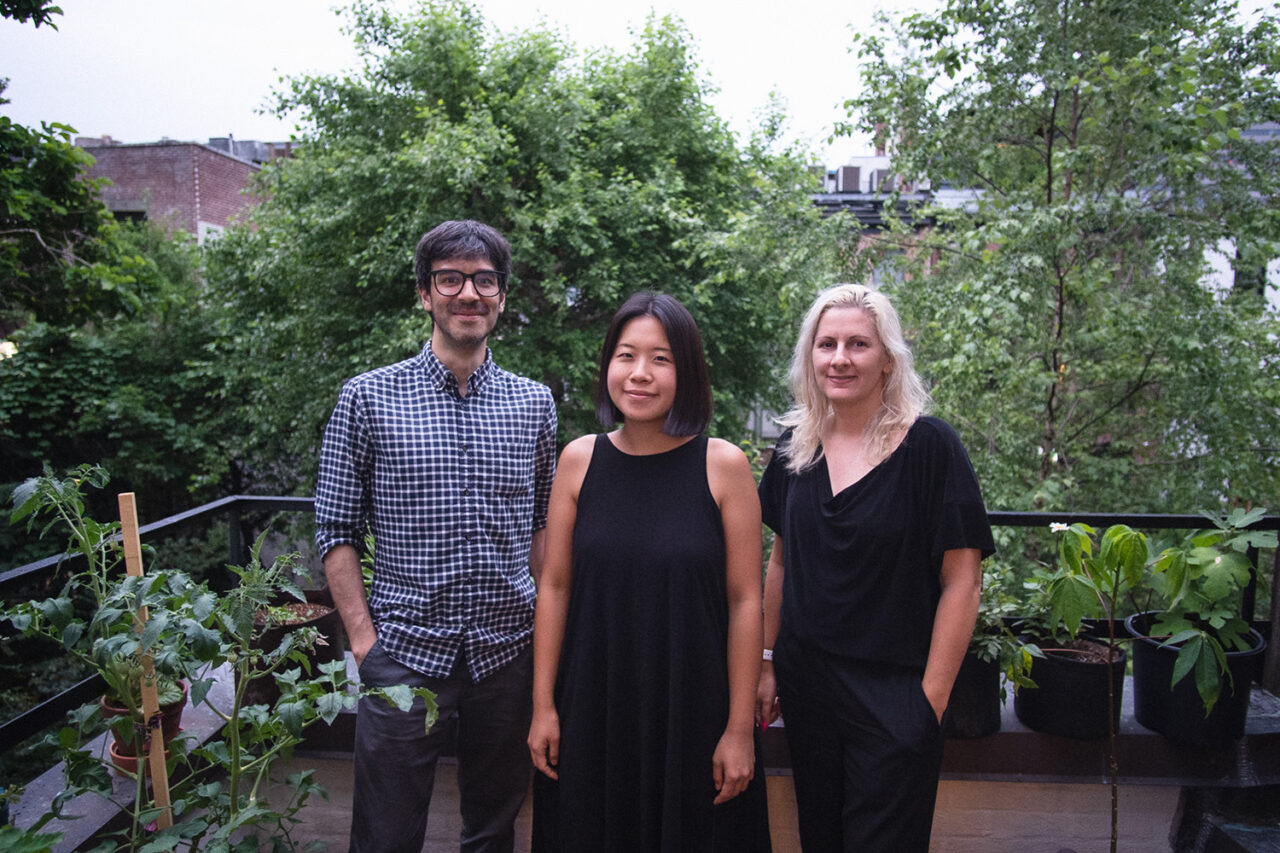
Friends Making Work is a design collective and practice of material interests based in NYC. With cumulative backgrounds in architecture, illustration, urban design, and film, the group’s material interventions span exhibitions, media, and transdisciplinary design. Past projects include D.E.P.O.T. I Gross Domestic Practices and Planetary Home Improvement: From Just-in-time to Geological Time, both concerned with systems of material extraction, waste and re-use. Friends Making Work co-founders are Amelyn Ng, Gabriel Vergara, and Christine Giorgio.
Amelyn Ng is an architect, researcher, and Assistant Professor of Architecture at Columbia University GSAPP. Working at the intersection of architecture, media studies, and visual culture, her creative practice contends with relationships between digital representation and physical matter, seeking alternate narratives to the status quo of building. Ng has previously taught at Rice University, Melbourne University, and the Rhode Island School of Design. A registered architect in the State of Victoria, Australia, Ng holds a Bachelor of Environments and Master of Architecture from the University of Melbourne, and a Master of Science in Critical, Curatorial, and Conceptual Practices at Columbia GSAPP. She also draws cartoons.
Gabriel Vergara is an Architect, Urban Designer, and Adjunct Assistant Professor of Architecture and Urban Design at Columbia GSAPP. He has previously taught landscape and urban design studios at the Rhode Island School of Design and Universidad Andres Bello in Chile. Vergara has collaborated with organizations in the U.S. and Latin America, including the Center for Justice Innovation in New York, the Art Museum of Ciudad Juarez in Mexico, and AriztiaLAB in Santiago. He has contributed to architecture and urban design firms such as One Architecture & Urbanism in New York and 51-1 Arquitectos in Peru. Vergara was a co-founder of SUSUKA, an architecture studio based in Chile and the local branch of Supersudaca in Santiago, his work has been published internationally and featured in the Chilean Pavilion at the 12th Venice Biennale of Architecture in 2010. Vergara holds a Bachelor of Architecture from Universidad de Talca, Chile and Master of Science in Architecture and Urban Design at Columbia GSAPP.
Before pivoting to architecture, Christine Giorgio was active in the NYC independent film scene as a director, producer and editor working across documentary and fiction formats. Her films have been recognized by international film festivals and nominated for an Independent Spirit Award. Giorgio’s design practice synthesizes narrative concepts with spatial design, employing experimental approaches to excavate material truths. She is an AIA Associate and also works with clients on commercial and residential projects. Recent projects include a hemp-lime thermal retrofit in NYC and a ground-up residential construction on Long Island. Giorgio earned her M.Arch from Columbia University, where she was the recipient of the Lowenfish Memorial Prize.
Thank you to our CFA Lab 2026 Jury:
Barry Bergdoll, Hon. AIANY, Meyer Schapiro Professor of Art History and Archaeology, Columbia University
Graham Clegg, AIA, Principal, Studios Architecture
Kholisile Dhliwayo, RA NY, DC & CT, NCARB, ARBV, NSWARB, Architect & Curator
Anjelica Gallegos, Co-Founder, Indigenous Society of Architecture, Planning, and Design
Mark Gardner, AIA, NOMA, Principal, Jaklitsch/Gardner Architects; Assistant Professor of Architectural Practice and Society, Parsons The New School for Design
Christine Gaspar, Executive Director, Center for Urban Pedagogy
A.L. Hu, NOMA, AIA, NCARB, Architect & Curator
Karla Andrea Pérez, Co-Founder/Director Manhatitlan, Community Organizer & Curator
Monica Rhodes, President and Founder, Rhodes Heritage
Peter Robinson, Founder, WorkUrban; Assistant Professor, Cornell University Department of Architecture; Board Chair, Center for Architecture
Shawhin Roudbari, Dissent x Design, Assistant Professor, Program in Environmental Design, University of Colorado Boulder
Jennifer Sage, FAIA, President, Center for Architecture, Partner, Sage and Coombe
Tya Winn, Executive Director, Community Design Collaborative